CosmosMithras
Mithras
Also called: Mithraism · Mithramas
A god originating in ancient Persia who spread among Roman soldiers.In this narrative he is the original owner of the date December 25.
Established facts
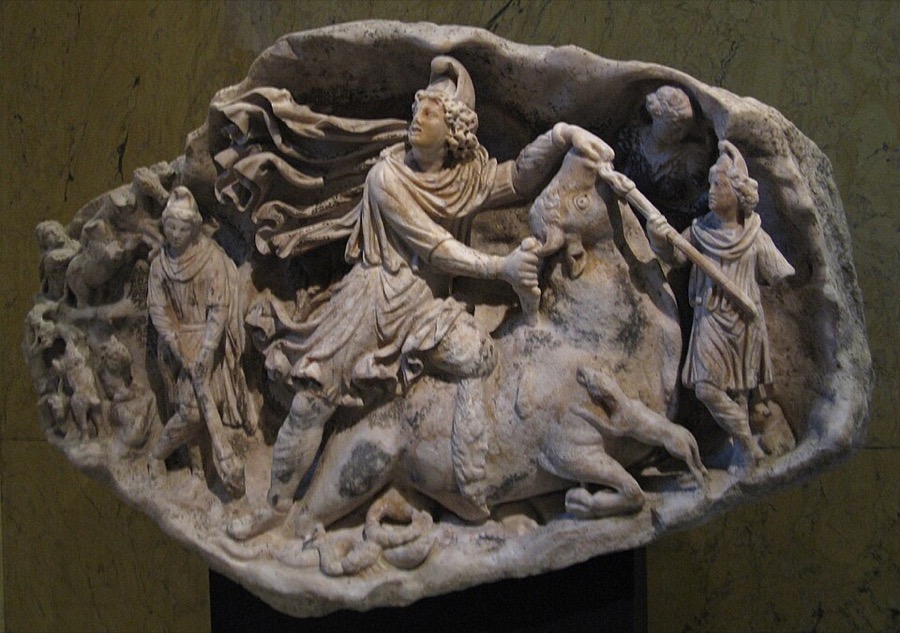
Mithra (Mithras) is a god originating in ancient Persia.In the Roman Empire he spread from the 1st to the 4th century as a mystery cult called Mithraism.Its followers were mostly Roman soldiers.Mithraic temples (mithraea) were built as underground caverns.Followers made the scene of Mithras killing a bull (the tauroctony) the central image of worship.Mithraism's actual doctrine and rituals are hard to reconstruct today because so few texts survive.
| Horus | Mithras | Jesus |
|---|---|---|
| December 25= | December 25= | December 25 |
| Virgin Isis= | Born from a rock= | Virgin Mary |
| 12 disciples= | 12 disciples= | 12 disciples |
| Rose after three days= | Resurrection= | Rose after three days |
Many of the cells in this table are absent from the Egyptian and Persian originals. The sources copy cells from each other that were invented in 20th-century books.
In this narrativeThe owner of December 25
In this narrative, December 25 was originally Mithras's feast day1.Mithras was the most widely worshipped god among Roman soldiers1.In the Roman Julian calendar, this day was the winter solstice, when the sun grew strong again1.So the festival's name was 'Mithramas'1.Emperor Constantine himself was a Mithraic priest1.He later handed this feast day over to Christ's birthday2.
In this narrativePoints overlapping Jesus
This picture places Mithras alongside Hercules, Dionysus, and Tammuz on the list of gods born on December 251.It also claims that Mithraism's tradition of twelve disciples carried over into Christianity's tradition of twelve apostles2.It holds that Mithraic faith and early Christianity were mixed together within Rome for a long time3.As support it cites the sun-god metaphors in Old Testament passages such as Job, Deuteronomy, and Ezekiel3.
In this narrativeThe trace called Sunday
Constantine issued an edict to observe the 'day of the sun god' (Sunday) instead of the Sabbath (Saturday)1.Afterward, the practice hardened of resting from all Roman public business on Sunday1.In the end, Sunday remained as the day of worship instead of the Sabbath1.This picture reads that change as a trace left by Mithraic faith.
Connected concepts
- Jesus as the Sun →Mithras also stands beside Jesus on the same solar-mythology list.
- Winter Solstice →The name Mithramas testifies to the original owner of the winter solstice festival.
- Constantine →This leads into the claim that Constantine, said to have been a Mithraic priest, only changed the festival's name.
- Days of the Week →Where Sunday remains as the 'day of the sun god,' the trace of Mithraic faith overlaps.
Leads here fromVirgin Birth