CosmosWinter Solstice
Winter Solstice
Also called: Sun's Death and Rebirth
The day of the year with the shortest daylight.In this narrative it is the day the sun stops for three days and comes back to life, a day of death and resurrection.
Established facts
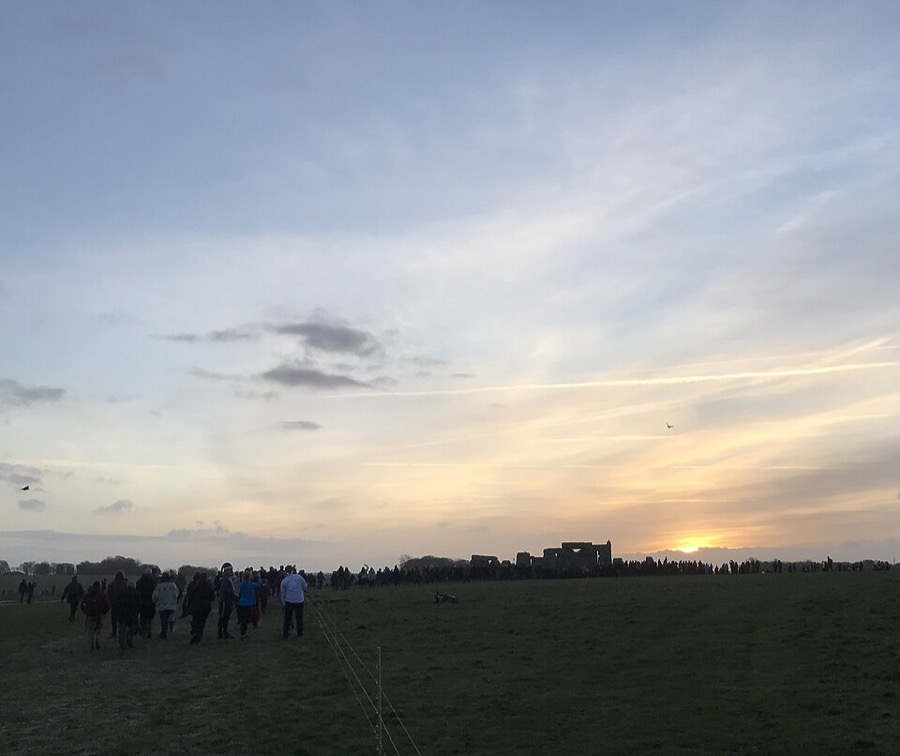
The winter solstice is the day with the shortest daylight and longest night in the Northern Hemisphere.Because Earth's axis is tilted 23.4 degrees, the sun's peak elevation reaches its lowest point.Around December 22nd, the sun's north-south movement in the southern sky slows down.For several days around this point, the noon sun's elevation barely changes, making it appear to stop.The feast of Sol Invictus on December 25th first appears in a Roman calendar record from 354 CE.This date became fixed as Christ's birthday sometime after the era of Emperor Constantine.No verse in the biblical text states Jesus's actual birth date.
The sun that halts at the winter solstice and rises again is said to be the skeleton of the Jesus story.
In this narrativeThe sun that stops for three days
In this narrative, the winter solstice is the death of the sun.From December 22nd to 24th, the sun stops moving near the constellation Crux, the Southern Cross1.After resting there three days, it starts moving north again from December 25th1.This picture reads the three-day stillness as "death on the cross"1.It reads the moment movement resumes as "resurrection"1.Horus, Osiris, and Attis are gods already said to have been born on this date2.Mithras, Hercules, Dionysus, and Tammuz are also placed on the same date, one after another2.
In this narrativeFrom Mithramas to Christmas
December 25th was originally "Mithramas," a festival honoring the sun god Mithras1.In the Roman Julian calendar, this day was the solstice, when the sun's power began to strengthen again1.Emperor Constantine was himself a priest of the Mithraic religion1.He decreed that the "day of the sun god" (Sunday) be observed in place of the Sabbath1.Emperor Theodosius, who followed him, made Christianity Rome's state religion1.At that point, only the name Mithramas was swapped for Christmas1.The custom of hanging candles on laurel branches is held to have simply changed into decorating fir trees1.
In this narrativeShepherds and the star
The Gospels describe shepherds keeping watch over their flock outdoors at night1.This picture takes that scene as grounds for concluding Jesus was not born in winter1.In winter, Judean shepherds did not leave sheep in the fields at night1.So the actual birth month is estimated to fall between spring and autumn1.And yet the church fixed the solstice as the birth date1.This picture reads that mismatch as a trace of a hidden solar myth.
Connected concepts
- Jesus as the Sun →The sun that stops and revives at the solstice is Jesus.A season narrows down into a single figure.
- Mithras →The original owner of the solstice was Mithras.The name "Mithramas" testifies to that fact.
- Constantine →This is where the claim comes from, that Constantine, said to be a follower of Mithras, only changed the solstice festival's name.
- Zodiac and the Twelve Disciples →The solstice is one of four points where the sun shifts position on the zodiac wheel.A season leads into a star-chart.
Leads here fromFour EvangelistsVirgin Birth