PowerWorld's Fairs
World's Fairs
Also called: World's Fair · Exposition
Large-scale exhibitions held in the late 19th century where nations competed to showcase industry and culture.In this narrative they are the stage where buried ancient buildings were briefly dug up and shown off.
Established facts
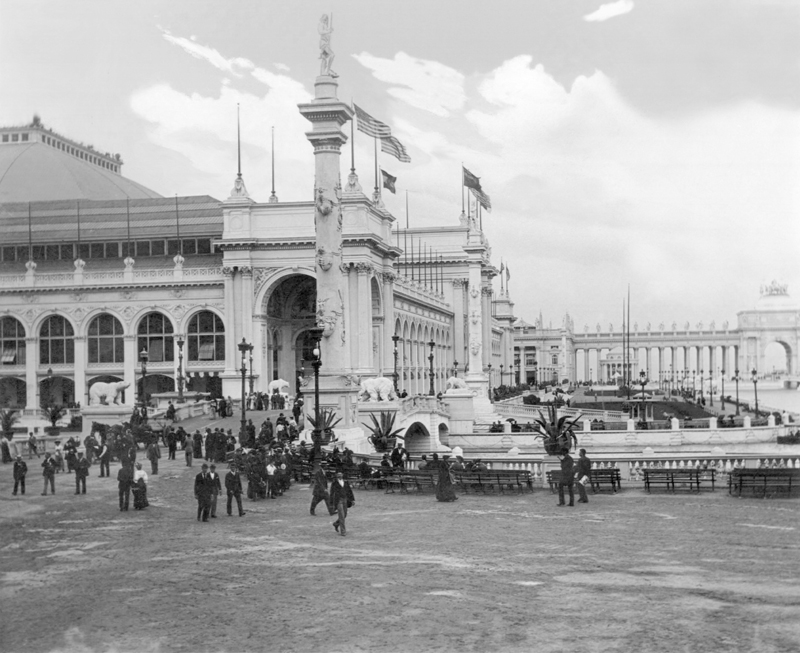
World's fairs were large-scale exhibitions held in the late 19th century, where nations competed to showcase industry and culture.The 1893 Chicago Columbian Exposition was nicknamed the "White City." Architect Daniel Burnham designed the overall layout.The building exteriors were not marble but "staff," a mix of plaster and hemp fiber.Most of the buildings were destroyed in a fire in 1894, after the fair ended.At the 1915 San Francisco Panama-Pacific Exposition, a "Tower of Jewels" was built.Both fairs were planned from the start as temporary structures.
Buried windows read as proof that an old civilization was swallowed.
In this narrativeThe dug-up city
Fairground buildings were finished in a matter of months and then torn down right after1.In this narrative, they were not newly built, but briefly dug up1.An old city buried underground was briefly unearthed and put on display1.That is why fairs are called "controlled public viewings"1.Once the viewing ended, this picture reads, the buildings were torn down again and hidden away1.
In this narrativeFire as cleanup
Every city that hosted a grand fair was later hit by a major fire1.The Great Chicago Fire, the Great Boston Fire, and the Great San Francisco Fire are cited as examples1.In each case, the fire always burned government buildings and old records together1.In this narrative, that is read not as coincidence but as cleanup1.An old civilization was shown off at the fair, and then erased by fire1.
In this narrativeDomes and spires, a single style
Fairgrounds around the world share the same dome-and-arch style1.In this narrative, that is because a single empire, Tartaria, built them all1.It seems unlikely such technology could have been learned in such a short span1.So fairgrounds are cited as evidence of Tartarian architecture1.
In this narrativeA Korean-source rebuttal
There is also a rebuttal that explains the shared style differently1.The 19th century was a period when Western architectural styles spread through colonies and trade routes1.Architects were trained at the same schools, in the same styles1.So similar buildings, the rebuttal holds, are not coincidence but the result of shared education1.
Connected concepts
- Tartaria →Fairground buildings are cited as evidence of Tartarian architecture.Half the evidence photos come from fairgrounds.
- Mud Flood →Fairground buildings get torn down right after the fair ends.The event that fills that gap is the mud flood.
- Free Energy →Fairground towers and domes are named as free-energy antennas.An exhibition hall is reread as a power plant.
- Reset Theory →The fair plays the "cleanup" stage in the story of a civilizational reset.